Fixed dental bridges in Grand Rapids, MI that replace one or more missing teeth permanently, designed and fabricated in our on-site laboratory for a precise, natural fit.
Greenland Advanced Oral Care
Bridges in Grand Rapids
A bridge fills a gap by anchoring replacement teeth to the teeth on either side. It is fixed in place (you do not take it out) and it restores chewing and appearance in a few weeks rather than the months an implant requires. For the right case it is an excellent, long-proven solution.
We assess the health, root support, and bone level of the teeth on each side of the gap. A bridge is only as sound as what holds it up, so this decides whether it is the right option.
Step 2
Preparation and temporary
The supporting teeth are shaped under local anesthesia and scanned digitally. You wear a temporary bridge while the final one is fabricated, so the gap is never visible.
Step 3
Fabrication in our laboratory
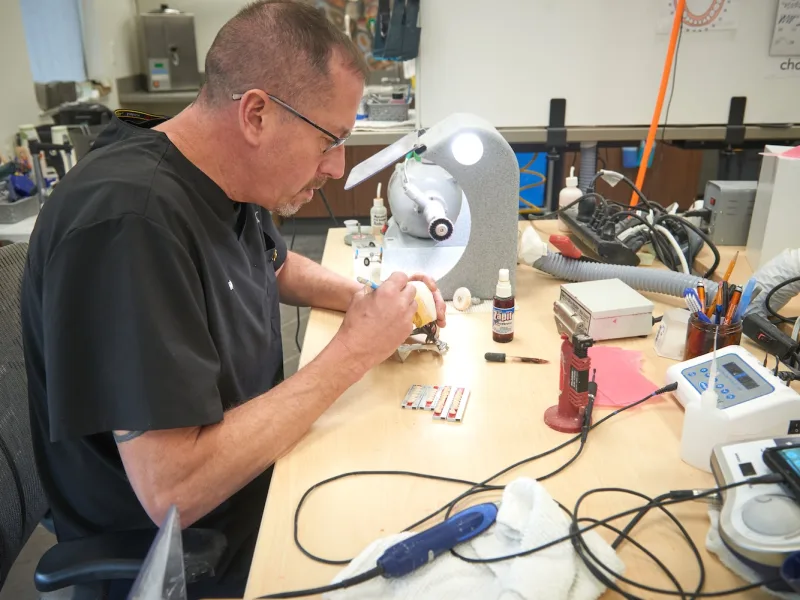
Your bridge is made on site, shade-matched in person, then fitted and adjusted so the bite is even across every unit before it is cemented.
Why patients choose it
Benefits of bridges
Fills the gap permanently: nothing to remove or soak overnight
Restores chewing efficiency and clearer speech
Stops neighboring teeth from drifting into the empty space
Completed in weeks rather than the months implants require
Often a good fit when the supporting teeth already need crowns
Designed and fabricated in our own on-site laboratory
The basics
About bridges
A traditional bridge is a single piece: crowns on the supporting teeth at each end, with one or more artificial teeth suspended between them. The supporting teeth carry the extra chewing load, which is why their health matters so much in deciding whether a bridge is appropriate.
The main trade-off is that the supporting teeth must be reshaped to receive crowns, even if they are perfectly healthy. That is irreversible. A [dental implant](/services/dental-implants/) avoids it entirely by standing on its own. We walk through both honestly: if your neighboring teeth are pristine and you are a good implant candidate, we will usually say so, and if those teeth already need crowns anyway, a bridge often becomes the efficient choice.
New Patient Special
FREE Electric Toothbrush
Complete your first appointment and get a FREE electric toothbrush. Your visit includes a dentist consultation, comprehensive exam, X-rays if needed, a detailed oral scan, and a cleaning if applicable.
New patients only. One per patient. Mention this offer when booking.
Types of bridges
Traditional bridge. Crowns on the teeth at both ends of the gap, supporting the replacement tooth between them. This is the most common design and the most predictable.
Cantilever bridge. Supported on one side only. Used sparingly, in low-force areas, when there is no suitable tooth on the other side.
Maryland bridge, a replacement tooth held by thin wings bonded to the backs of the adjacent teeth. Far more conservative since the supporting teeth are barely touched, but less strong; best for front teeth.
Implant-supported bridge. Anchored to dental implants rather than natural teeth. This is the option when several teeth in a row are missing, or when you would rather not reshape healthy teeth.
Why replacing a missing tooth matters
A gap is not just cosmetic. Teeth are held in position by their neighbors, and when one is removed the surrounding teeth begin to tilt and drift into the space while the opposing tooth over-erupts toward the gap. Over a few years that changes how your teeth meet, concentrates force in the wrong places, and makes cleaning harder, which invites gum disease and decay.
The jawbone under the gap also loses stimulation and begins to resorb. A bridge stops the drifting but does not preserve the bone the way an implant does, which is part of the trade-off we discuss.
Making the choice
If you are dealing with missing teeth, the honest answer is that the right option depends on your specific mouth: how healthy the neighboring teeth are, how much bone you have, your timeline, and your budget. Some patients are better served by a partial denture; others by implants; others by a bridge.
Dr. Greenland’s prosthodontic training is exactly the background for making that call well. Book a consultation and we will lay out every option side by side, including the ones that cost less.
Still have questions? Contact us: we're happy to help.
How long does a dental bridge last?+
Many bridges last ten to fifteen years or more. The limiting factor is usually the health of the supporting teeth, since decay at their margins is the most common reason a bridge has to be replaced.
Bridge or implant, which is better?+
Neither is universally better. An implant preserves jawbone and leaves the neighboring teeth untouched, but costs more and takes months. A bridge is faster and can make good sense when the adjacent teeth already need crowns. We will give you a straight recommendation for your situation.
How do I clean under a bridge?+
Because the artificial tooth sits against the gum, regular floss will not pass through. You use a floss threader or an interdental brush to clean underneath daily. We will show you exactly how at your fitting.
Does getting a bridge hurt?+
Preparation is done under local anesthesia and should be comfortable. Mild sensitivity in the supporting teeth for a few days afterward is normal.
How many teeth can a bridge replace?+
Commonly one to three, depending on the strength and position of the supporting teeth. Longer spans put more stress on the supports; beyond a certain point, implants or a partial denture become the more predictable option.
Will the bridge match my other teeth?+
Yes. Shade, shape, and translucency are matched in our on-site lab with your teeth in front of the technician, which is a meaningful advantage over sending the case out.
Will insurance cover a bridge?+
Many plans contribute toward bridges as a restorative procedure. We are fee-for-service and will file your claim as a courtesy, with reimbursement sent directly to you. Financing is available.
“Life Changing Transformation.
My teeth were a wreck. I had missing, broken, and discolored teeth. I had to watch what I ate because food would always get stuck in my teeth. I rarely ever smiled, and never when my picture was taken.
Best investment of my life, so glad that I found Dr. Greenland, can’t say enough about how amazing he is and the master craftsmanship Dentistry he does!
Dr. Greenland’s staff and facility is also amazing!
Dr. Greenland and Dentistry Team, I want you to know that I am very appreciative of the work, time, effort and professionalism you put into my Dental reconstruction. Thank you!
Eric”
ESE. ShieldsVerified review · Google”
“Best people ever thoughtful considerate couldn't be better”
DVDebbie VromaVerified review · Google”
“I have been treated with nothing but compassion with all the issues I have had, they are redoing implants both upper and lower that someone else did that have been giving me problems for five years. I am more than halfway through the process and can really feel the improvements, I am very grateful that I was referred to Greenland Advanced Oral Care. Everyone is just amazing they really care about you, I would highly recommend them.”