
Teeth Grinding Treatment in Grand Rapids
Teeth grinding and clenching treatment in Grand Rapids, MI. Custom night guards and bite restoration that stop enamel wear, cracked teeth, and morning jaw pain.
Dental treatment for teeth grinding
Get to the root of your teeth grinding
Also known as: Bruxism, Clenching, Jaw clenching, Grinding at night
Grinding and clenching generate forces well beyond normal chewing, sustained for hours while you are asleep and have no protective reflexes. Most people do not know they do it until a dentist points out the wear. Left alone, it flattens teeth, cracks enamel, and breaks restorations, and the damage is not reversible.
Symptoms of teeth grinding
- ✓Waking with a sore jaw, tight facial muscles, or a headache
- ✓Teeth that look flattened, shortened, or chipped at the edges
- ✓Increased sensitivity to hot and cold across several teeth
- ✓A partner who hears grinding during the night
- ✓Aching or clicking in the jaw joint, or limited opening
- ✓Restorations that keep fracturing or coming loose
Common causes
- Stress and anxiety, the most commonly reported trigger
- Sleep-disordered breathing, including obstructive sleep apnea
- An uneven bite creating interfering contacts between teeth
- Certain medications, particularly some antidepressants
- Caffeine, alcohol, nicotine, and recreational stimulants
- Missing teeth changing how the remaining teeth meet
Our approach
How we treat teeth grinding in Grand Rapids
- Step 1
Confirm it and find the driver
Wear facets, enamel cracks, muscle tenderness, and a scalloped tongue border tell us it is happening. We also ask about sleep quality, because sleep-disordered breathing is a frequent and important driver.
- Step 2
Protect the teeth now
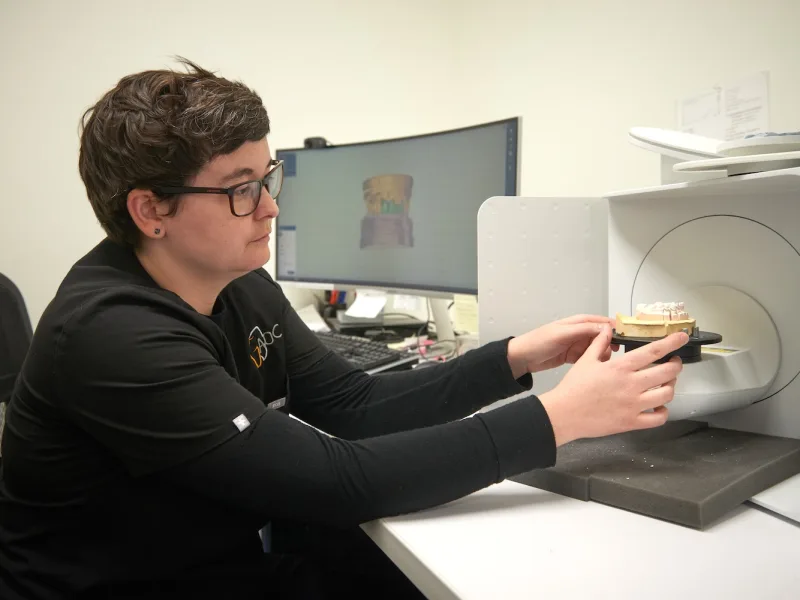
A custom night guard fabricated in our own laboratory puts a replaceable layer between your teeth. It stops the damage while the underlying cause is addressed.
- Step 3
Restore what has been lost
Where wear has already shortened the teeth or collapsed the bite, we rebuild it, sometimes with crowns, sometimes as staged full-mouth reconstruction.
The basics
Understanding teeth grinding
Bruxism is involuntary grinding or clenching, most commonly during sleep. Awake clenching during concentration or stress is also common and often unnoticed. The forces involved are substantially higher than normal chewing and are applied for far longer, because the protective feedback that stops you biting too hard while awake is suppressed during sleep.
The damage accumulates slowly and quietly. Enamel wears flat, exposing the softer dentin underneath, which then wears faster still. Microscopic fatigue cracks develop and eventually propagate into [fractured cusps](/symptoms/chipped-teeth/). Crowns and fillings fail earlier than they should. Over decades the vertical height of the bite can collapse, changing the jaw position and the appearance of the lower face, at which point the fix is no longer a night guard but full reconstruction.
New Patient Special
FREE Electric Toothbrush
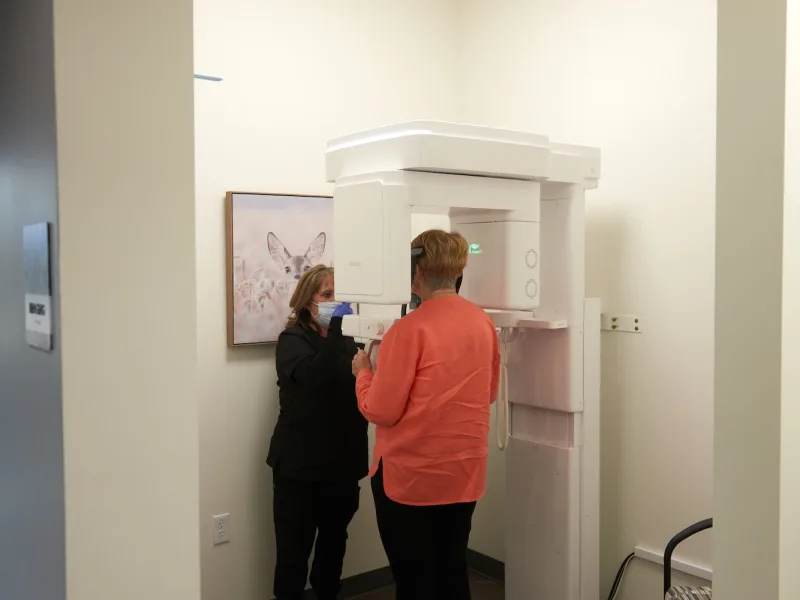
Complete your first appointment and get a FREE electric toothbrush. Your visit includes a dentist consultation, comprehensive exam, X-rays if needed, a detailed oral scan, and a cleaning if applicable.
New patients only. One per patient. Mention this offer when booking.
What grinding does, in order
- Enamel flattens. The pointed cusps of molars and the edges of front teeth wear into flat surfaces.
- Dentin is exposed. Softer than enamel, it wears faster, and teeth become sensitive.
- Cracks develop. Fatigue cracks appear in the enamel and gradually propagate.
- Restorations fail. Crowns and fillings fracture or debond earlier than they should.
- Teeth fracture. A cusp breaks off, sometimes past the point of repair.
- The bite collapses. With enough vertical height lost, the jaw closes further than it should, the lower face shortens, and the joints work in a different position.
Intervening at stage one or two costs the price of a night guard. Intervening at stage six means full-mouth reconstruction.
The sleep connection
Sleep bruxism has a well-documented association with sleep-disordered breathing. Grinding episodes often occur around arousals from sleep, and for some patients the clenching relates to airway obstruction.
This matters because a night guard treats the teeth while leaving a potentially significant medical condition unaddressed. If you snore, stop breathing during sleep, wake unrefreshed, or have daytime sleepiness, we will suggest a sleep evaluation. Untreated obstructive sleep apnea carries cardiovascular and metabolic consequences well beyond your teeth.
Treatment
Custom night guard: the first line. Made in our laboratory to fit your teeth precisely, at the right thickness for how heavily you grind.
Occlusal splint, where jaw joint pain or muscle spasm is prominent, a splint designed to position the jaw rather than simply cover the teeth. Dr. Greenland’s prosthodontic training covers this bite analysis directly.
Bite correction, where interfering contacts contribute, alignment treatment or selective adjustment can reduce the trigger.
Restoring damage. Crowns for individual worn or cracked teeth.
Full-mouth reconstruction, when the bite height has collapsed, rebuilding it as a single coordinated design with the new position tested in provisionals first.
Managing the driver. Stress reduction, reviewing medications with your physician, reducing caffeine and alcohol, and treating sleep-disordered breathing.
Do not wait for it to hurt
Grinding damage is cumulative and permanent. Enamel does not grow back, and every year of unprotected grinding costs tooth structure that has to be rebuilt artificially later.
Waking with a sore jaw, or noticing your teeth looking shorter? Book an appointment. We will show you the wear pattern and tell you what stage you are at.
Why choose our practice
Protecting against grinding vs. leaving it
| Comparison factor | Wearing a Night Guard | Doing Nothing |
|---|---|---|
| What absorbs the force | ✓A replaceable appliance | ✕Your enamel, permanently |
| Crowns and fillings | ✓Protected, lasting longer | ✕Fracture and fail early |
| Morning jaw pain | ✓Often reduced | ✕Persists or worsens |
| Bite height | ✓Preserved | ✕Collapses gradually over years |
| Eventual treatment | ✓Replace the guard periodically | ✕Crowns, or full-mouth reconstruction |
Treatment options
Treatments we use for teeth grinding
Crowns
Custom dental crowns in Grand Rapids, MI, milled and shade-matched in our on-site laboratory to restore cracked, worn, or heavily filled teeth with a natural-looking fit.
Learn more →Mouth Guards
Custom night guards and sports mouth guards in Grand Rapids, MI, made in our on-site dental lab to protect teeth from grinding, clenching, and athletic injury.
Learn more →Invisalign
Invisalign clear aligners in Grand Rapids, MI with certified provider Dr. Eryn Huber. Straighten crowded, gapped, or shifted teeth without metal braces.
Learn more →Restorative Dentistry
Restorative dentistry in Grand Rapids, MI. Fillings, crowns, bridges, and implant restorations that rebuild damaged and missing teeth and return normal function.
Learn more →Full Mouth Reconstruction
Full mouth reconstruction in Grand Rapids, MI. A Mayo Clinic-trained prosthodontist rebuilds worn, damaged, or missing teeth as one coordinated, staged treatment plan.
Learn more →Related conditions
Other conditions we treat in Grand Rapids
Patient reviews
What our Grand Rapids patients say
“Life Changing Transformation. My teeth were a wreck. I had missing, broken, and discolored teeth. I had to watch what I ate because food would always get stuck in my teeth. I rarely ever smiled, and never when my picture was taken. Best investment of my life, so glad that I found Dr. Greenland, can’t say enough about how amazing he is and the master craftsmanship Dentistry he does! Dr. Greenland’s staff and facility is also amazing! Dr. Greenland and Dentistry Team, I want you to know that I am very appreciative of the work, time, effort and professionalism you put into my Dental reconstruction. Thank you! Eric”
“Best people ever thoughtful considerate couldn't be better”
“I have been treated with nothing but compassion with all the issues I have had, they are redoing implants both upper and lower that someone else did that have been giving me problems for five years. I am more than halfway through the process and can really feel the improvements, I am very grateful that I was referred to Greenland Advanced Oral Care. Everyone is just amazing they really care about you, I would highly recommend them.”
How do I know if I grind my teeth?+
Common signs are waking with a sore jaw or headache, teeth that look flat or chipped at the edges, widespread sensitivity, and a partner hearing it at night. We can also see it directly during an exam. Wear facets are distinctive and hard to mistake.
Will a night guard stop me from grinding?+
No. It protects your teeth from the consequences and often reduces muscle soreness, but the habit itself continues. Addressing stress, sleep quality, and any bite interference is what reduces the grinding.
Is a custom night guard better than a drugstore one?+
Considerably. Boil-and-bite guards fit loosely and are bulky, and many people unconsciously clench harder to hold them in place. A custom guard fits precisely, is far more comfortable, and is much more likely to be worn every night.
Can grinding be related to sleep apnea?+
Yes, and this is important. Sleep bruxism is associated with sleep-disordered breathing. Grinding sometimes occurs in connection with arousals from airway obstruction. If you snore, wake unrefreshed, or have daytime sleepiness, a sleep evaluation is worth pursuing.
Why do my teeth hurt in the morning?+
Hours of sustained clenching inflames the ligament around each tooth and fatigues the chewing muscles. Both produce diffuse aching that is worst on waking and eases through the morning.
Can grinding damage be repaired?+
Yes. Individual worn or cracked teeth are restored with crowns. When wear is widespread and the bite height has collapsed, it is rebuilt as full-mouth reconstruction, where the new bite is tested in provisionals before anything permanent is made.
Do children grind their teeth?+
Many do, and most outgrow it without lasting damage to the baby teeth. It is worth mentioning at checkups so we can monitor wear, and worth investigating if it comes with snoring or disturbed sleep.
Does insurance cover a night guard?+
Many plans cover a portion when it is prescribed for bruxism. We are a fee-for-service practice and file claims as a courtesy so any reimbursement goes directly to you.