
Cavities Treatment in Grand Rapids
Cavity treatment in Grand Rapids, MI. We find decay early with digital X-rays and restore teeth with tooth-colored fillings before the damage reaches the nerve.
Dental treatment for cavities
Get to the root of your cavities
Also known as: Tooth decay, Dental caries, Rotten teeth
A cavity is a hole in the tooth caused by bacterial acid dissolving the enamel. It does not hurt until it is well advanced, which is why most cavities are found on a routine exam rather than by the patient. Caught at that stage, treatment is a single tooth-colored filling.
Symptoms of cavities
- ✓Sensitivity to sweet, hot, or cold foods and drinks
- ✓A visible dark spot, white chalky patch, or hole in a tooth
- ✓Food consistently catching in the same spot between teeth
- ✓A rough or sharp edge you keep finding with your tongue
- ✓Toothache or pain when biting down
- ✓Persistent bad taste or bad breath from a decayed area
Common causes
- Bacteria in plaque converting dietary sugars into enamel-dissolving acid
- Frequent snacking or sipping sweet drinks, which keeps acid levels high
- Inadequate brushing and flossing, especially between teeth
- Dry mouth from medications, which removes saliva's protective buffering
- Deep grooves in molars that trap plaque beyond a toothbrush's reach
- Receding gums exposing root surfaces, which decay faster than enamel
Our approach
How we treat cavities in Grand Rapids
- Step 1
Find it early
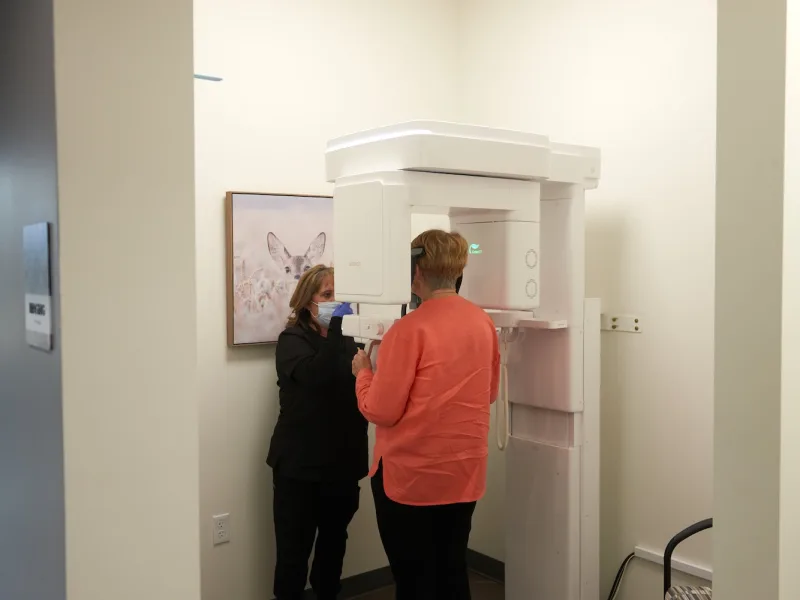
Digital X-rays reveal decay between teeth and under existing fillings, where a visual exam cannot see. Most cavities are found here, well before they cause any symptom.
- Step 2
Treat conservatively
Very early lesions may be remineralized with fluoride rather than drilled. Established cavities get a bonded tooth-colored filling, removing only the decayed structure.
- Step 3
Address why it happened
Multiple cavities point to a cause. Dry mouth, diet frequency, a hygiene gap, or exposed roots. We identify it, or you will be back for the same treatment.
The basics
Understanding cavities
Decay is a process, not an event. Bacteria in dental plaque feed on sugars and produce acid that pulls minerals out of enamel. Between meals, saliva neutralizes that acid and puts some minerals back. Whether a cavity forms depends on which direction that balance tips over months, and frequency of sugar exposure matters more than the total amount, because each exposure restarts the acid cycle.
In the earliest stage, demineralization shows as a chalky white spot and is still reversible with fluoride and better hygiene. Once the surface collapses into the softer dentin beneath, it cannot heal. From there, decay spreads faster because dentin is less mineralized, and if it reaches the pulp the tooth needs root canal treatment rather than a filling. The window between "small filling" and "root canal and crown" is often a year or two of no symptoms at all.

New Patient Special
FREE Electric Toothbrush
Complete your first appointment and get a FREE electric toothbrush. Your visit includes a dentist consultation, comprehensive exam, X-rays if needed, a detailed oral scan, and a cleaning if applicable.
New patients only. One per patient. Mention this offer when booking.
Why cavities are usually found before you feel them
The nerve sits in the middle of the tooth, insulated by enamel and dentin. Decay has to travel a long way through both before it gets close enough to cause pain. By the time a tooth aches, the cavity is generally deep, and the treatment has escalated from a filling to root canal treatment and a crown.
This is the entire argument for routine cleanings and exams. We are not looking for something you have noticed. We are looking for what you cannot notice yet.
How we treat decay
Very early lesions. A white-spot lesion with an intact surface can often be remineralized with fluoride, better home care, and a change in snacking pattern. No drilling.
Established cavities. Decayed structure is removed and the tooth restored with bonded tooth-colored composite. Usually one visit.
Extensive decay. When too little healthy tooth remains for a filling to hold, a crown wraps and supports the tooth. If decay has reached the nerve, root canal treatment comes first.
Non-restorable teeth. Occasionally decay has gone too far. Then it becomes oral surgery followed by an implant or bridge to replace the tooth.
Finding the reason, not just the hole
An adult who suddenly develops several cavities after years without any usually has a specific cause:
- Dry mouth from blood pressure medication, antidepressants, antihistamines, or cancer treatment. Less saliva means less buffering and less remineralization.
- Frequent sipping, a sweetened coffee or soda nursed over two hours does far more damage than the same drink consumed in ten minutes.
- Gum recession from gum disease, exposing root surfaces that decay considerably faster than enamel.
- A hygiene blind spot, often the back molars or one specific area that a habitual brushing pattern misses.
Fixing the fillings without fixing the cause means repeating the appointment in eighteen months.
Related conditions
Decay often travels with gum disease and chronic bad breath, since all three share bacterial plaque as the driver. Weakened, decayed teeth are also more likely to become chipped or fractured teeth.
Overdue for a checkup, or suspect a cavity? Book an appointment. New patients receive a free electric toothbrush with their first visit.
Why choose our practice
Treating a cavity early vs. waiting
| Comparison factor | Treating It Early | Waiting Until It Hurts |
|---|---|---|
| Treatment needed | ✓A single tooth-colored filling | ✕Root canal plus a crown, or extraction |
| Appointment time | ✓One short visit | ✕Multiple longer visits |
| Cost | ✓Lowest-cost restorative treatment | ✕Several times higher |
| Tooth structure kept | ✓Most of the natural tooth preserved | ✕Substantial loss; tooth becomes brittle |
| Pain involved | ✓Usually none before or after | ✕Often significant pain before treatment |
Treatment options
Treatments we use for cavities
Crowns
Custom dental crowns in Grand Rapids, MI, milled and shade-matched in our on-site laboratory to restore cracked, worn, or heavily filled teeth with a natural-looking fit.
Learn more →General Dentistry
Family general dentistry in Grand Rapids, MI. Exams, cleanings, fillings, and oral cancer screening with Dr. Eryn Huber, in-network with Delta Dental of Michigan.
Learn more →Teeth Cleaning
Professional teeth cleaning in Grand Rapids, MI. Routine and deep cleanings that remove tartar, treat gum inflammation, and prevent cavities and gum disease.
Learn more →Fillings
Tooth-colored composite fillings in Grand Rapids, MI that repair cavities and small chips, bonded to match your natural enamel and restore the tooth's strength.
Learn more →Restorative Dentistry
Restorative dentistry in Grand Rapids, MI. Fillings, crowns, bridges, and implant restorations that rebuild damaged and missing teeth and return normal function.
Learn more →Related conditions
Other conditions we treat in Grand Rapids
Patient reviews
What our Grand Rapids patients say
“Life Changing Transformation. My teeth were a wreck. I had missing, broken, and discolored teeth. I had to watch what I ate because food would always get stuck in my teeth. I rarely ever smiled, and never when my picture was taken. Best investment of my life, so glad that I found Dr. Greenland, can’t say enough about how amazing he is and the master craftsmanship Dentistry he does! Dr. Greenland’s staff and facility is also amazing! Dr. Greenland and Dentistry Team, I want you to know that I am very appreciative of the work, time, effort and professionalism you put into my Dental reconstruction. Thank you! Eric”
“Best people ever thoughtful considerate couldn't be better”
“I have been treated with nothing but compassion with all the issues I have had, they are redoing implants both upper and lower that someone else did that have been giving me problems for five years. I am more than halfway through the process and can really feel the improvements, I am very grateful that I was referred to Greenland Advanced Oral Care. Everyone is just amazing they really care about you, I would highly recommend them.”
How do I know if I have a cavity?+
Frequently you cannot tell. Early decay is painless, and cavities between teeth are invisible without X-rays. Sensitivity to sweet or cold, a dark spot, or food catching in one place can be signs, but the reliable method is a routine exam.
Can a cavity heal on its own?+
Only at the very earliest stage. A white-spot lesion where enamel has lost minerals but the surface is intact can remineralize with fluoride and improved hygiene. Once there is an actual hole, the damaged structure has to be removed and restored.
Does getting a filling hurt?+
The tooth is numbed with local anesthesia, so the procedure should be comfortable. Mild sensitivity to cold or pressure for a few days afterward is normal, particularly on deeper fillings.
Why do I keep getting cavities even though I brush?+
Brushing alone misses the surfaces between teeth, where many cavities start. Other common causes are dry mouth from medication, frequent sipping of sweet or acidic drinks, and gum recession exposing softer root surfaces. We look for the specific pattern.
Are cavities in baby teeth worth treating?+
Yes. Untreated decay in baby teeth causes pain and infection, can damage the developing permanent tooth beneath, and early loss of a baby tooth lets the neighboring teeth drift into the space the adult tooth needs.
What happens if I ignore a cavity?+
It keeps growing. It reaches the nerve, which causes real pain and requires root canal treatment and a crown. Untreated beyond that, the tooth may develop an abscess and need extraction, after which you are looking at an implant or bridge.
How can I prevent cavities?+
Brush twice daily with fluoride toothpaste, clean between your teeth daily, reduce how often you consume sugar rather than only how much, drink water through the day, and keep regular cleanings so problems are caught while small.