
Oral Cancer Screening in Grand Rapids
Oral cancer screening in Grand Rapids, MI at every exam, with a prosthodontist fellowship-trained in oral oncology at MD Anderson Cancer Center.
Dental treatment for oral cancer
Get to the root of your oral cancer
Also known as: Mouth cancer, Oral cavity cancer, Oropharyngeal cancer
Oral cancer is highly treatable when it is caught early and much less so when it is not. It is usually painless at the stage where it is most treatable, which is why screening is part of every examination here rather than something you have to request.
Symptoms of oral cancer
- ✓A sore or ulcer in the mouth that has not healed in two weeks
- ✓A white or red patch on the tongue, gums, or lining of the mouth
- ✓A lump, thickening, or rough spot in the mouth or on the lip
- ✓Persistent difficulty or pain when chewing or swallowing
- ✓Numbness, or a persistent sensation of something caught in the throat
- ✓Unexplained bleeding, or a change in how your teeth fit together
Common causes
- Tobacco use in any form, including smokeless and vaping products
- Heavy alcohol use, with substantially higher risk combined with tobacco
- HPV infection, particularly HPV-16, linked to oropharyngeal cancers
- Prolonged sun exposure, a specific risk factor for lip cancer
- Age over 40, though incidence in younger adults is rising
- Previous head and neck cancer or a family history
Our approach
How we treat oral cancer in Grand Rapids
- Step 1
Screening at every exam
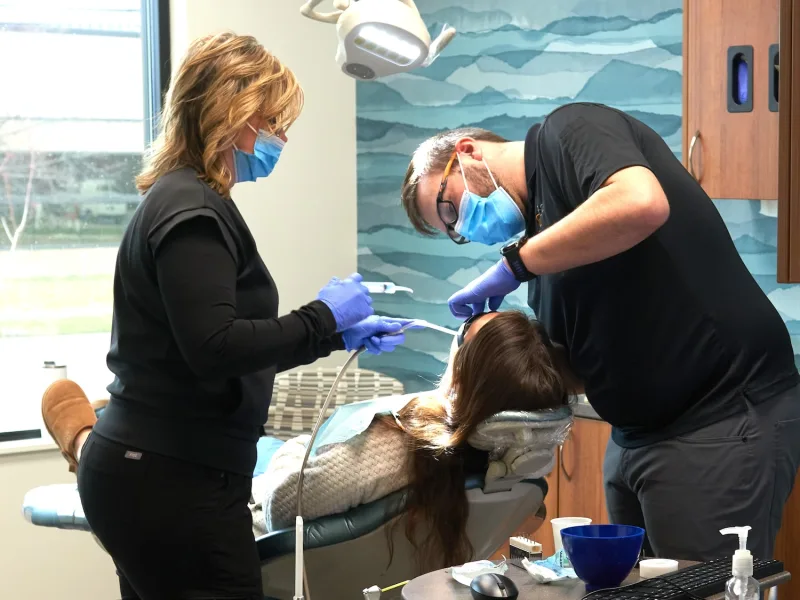
We systematically examine the tongue, floor of mouth, palate, cheeks, gums, lips, and throat, and palpate the neck and jaw for lumps, not only when a patient mentions something.
- Step 2
Track anything suspicious
Many oral lesions are benign. Anything that looks unusual is documented and re-examined after two weeks, a sore that has not healed in that window needs further investigation.
- Step 3
Refer promptly and clearly
If a lesion warrants biopsy or specialist evaluation, we say so directly and help coordinate the referral. We do not watch and wait on something that needs a diagnosis.
The basics
Understanding oral cancer
Oral cancer develops in the tissues of the mouth and throat: the tongue, floor of the mouth, palate, cheek lining, gums, lips, and oropharynx. Early lesions are typically small, painless, and easily mistaken for an ordinary irritation, which is the central problem: by the time a lesion causes symptoms that prompt someone to seek care, it has often progressed.
Survival is strongly stage-dependent. Localized disease detected early has a substantially better prognosis than disease that has spread to lymph nodes or beyond. That gap is why a two-minute soft tissue examination at a routine dental visit has real value. Dentists see the inside of the mouth more regularly than any other clinician, and are frequently the first to notice something abnormal.

New Patient Special
FREE Electric Toothbrush
Complete your first appointment and get a FREE electric toothbrush. Your visit includes a dentist consultation, comprehensive exam, X-rays if needed, a detailed oral scan, and a cleaning if applicable.
New patients only. One per patient. Mention this offer when booking.
Why this practice takes screening seriously
Dr. Greenland completed a year-long fellowship at MD Anderson Cancer Center focused on oral oncology and maxillofacial prosthetics, following his prosthodontic residency at Mayo Clinic. He also went through cancer treatment himself as a young man, before dental school.
That background shapes the practice in two ways. Screening is systematic at every exam rather than incidental, and this is a practice equipped to handle the dental side of cancer care, which is a genuinely specialized area.
Dental care during and after cancer treatment
Head and neck radiation and chemotherapy have significant oral consequences: severe dry mouth, rapid decay from lost saliva, mucositis, and risk of osteoradionecrosis in irradiated bone. Extractions after radiation carry real risk, which is why a dental evaluation before treatment starts matters so much.
We provide:
- Pre-treatment dental clearance and stabilization
- Management of dry mouth and the accelerated decay that follows it
- Maxillofacial prosthetics for patients with surgical defects affecting speech, swallowing, or appearance
- Prosthodontic reconstruction after treatment is complete
- Coordination with your oncology, ENT, and speech pathology teams
If you have been referred by an oncology team, or you are facing treatment and have been told to see a dentist first, contact us. This is routine work here.
What to watch for at home
Check monthly. Look at your tongue including the sides and underside, the floor of your mouth, your cheeks and gums, and your lips. Feel your neck and under your jaw for lumps.
The single most useful rule is the two-week rule: any sore, ulcer, patch, or lump that has not resolved within two weeks should be examined. Most will turn out to be nothing. The ones that are not benefit enormously from being looked at early.
Reducing your risk
- Stop tobacco in every form, including smokeless products and vaping
- Limit alcohol. Combined with tobacco the risk multiplies rather than adds
- Use lip balm with SPF if you work or spend time outdoors
- HPV vaccination reduces risk of HPV-related oropharyngeal cancers
- Keep regular dental visits so screening happens consistently
Related care
Oral cancer screening happens as part of general dentistry exams and alongside professional cleanings. Where a lesion requires biopsy or a tooth needs removal as part of treatment planning, that falls under oral surgery.
Noticed something that has not healed? Book an appointment rather than waiting for your next checkup.
Why choose our practice
Early detection vs. late detection
| Comparison factor | Found Early | Found Late |
|---|---|---|
| Typical stage at diagnosis | ✓Small, localized lesion | ✕Larger, often with lymph node spread |
| Prognosis | ✓Substantially better survival | ✕Markedly reduced |
| Treatment intensity | ✓More limited intervention | ✕Surgery plus radiation and chemotherapy |
| Effect on speech and eating | ✓Often minimal | ✕Frequently significant, needing rehabilitation |
| How it is usually found | ✓Routine screening, before symptoms | ✕Pain or difficulty swallowing prompts a visit |
Treatment options
Treatments we use for oral cancer
General Dentistry
Family general dentistry in Grand Rapids, MI. Exams, cleanings, fillings, and oral cancer screening with Dr. Eryn Huber, in-network with Delta Dental of Michigan.
Learn more →Oral Surgery
Oral surgery in Grand Rapids, MI. Extractions, bone grafting, and implant site preparation performed with a clear plan for what replaces the tooth afterward.
Learn more →Related conditions
Other conditions we treat in Grand Rapids
Patient reviews
What our Grand Rapids patients say
“Life Changing Transformation. My teeth were a wreck. I had missing, broken, and discolored teeth. I had to watch what I ate because food would always get stuck in my teeth. I rarely ever smiled, and never when my picture was taken. Best investment of my life, so glad that I found Dr. Greenland, can’t say enough about how amazing he is and the master craftsmanship Dentistry he does! Dr. Greenland’s staff and facility is also amazing! Dr. Greenland and Dentistry Team, I want you to know that I am very appreciative of the work, time, effort and professionalism you put into my Dental reconstruction. Thank you! Eric”
“Best people ever thoughtful considerate couldn't be better”
“I have been treated with nothing but compassion with all the issues I have had, they are redoing implants both upper and lower that someone else did that have been giving me problems for five years. I am more than halfway through the process and can really feel the improvements, I am very grateful that I was referred to Greenland Advanced Oral Care. Everyone is just amazing they really care about you, I would highly recommend them.”
What happens during an oral cancer screening?+
We visually examine the tongue including its sides and underside, the floor of the mouth, palate, cheeks, gums, and lips, and check the back of the throat. We also feel the neck, jaw, and floor of the mouth for lumps. It takes a couple of minutes and is painless.
How often should I be screened?+
At every routine dental examination: twice a year for most people. It is included as part of your visit here rather than being a separate service you have to ask for.
What should I watch for between visits?+
A sore that has not healed within two weeks, a white or red patch, a lump or thickening, persistent difficulty swallowing, numbness, or a change in how your teeth fit together. Any of these warrants a call rather than waiting for your next appointment.
Does a mouth sore mean I have cancer?+
Almost always no. Canker sores, irritation from a sharp tooth or denture, and infections are far more common. The distinguishing feature is duration. Ordinary sores heal within about two weeks, and one that does not needs to be looked at.
Who is at higher risk?+
Tobacco users in any form, heavy alcohol users, people with HPV-16 infection, those with significant sun exposure for lip cancer, and adults over 40. Risk from combined tobacco and alcohol use is considerably higher than either alone.
Can I get oral cancer if I have never smoked?+
Yes. HPV-related oropharyngeal cancers occur in people with no tobacco history, and incidence in that group has been rising. Never smoking lowers your risk substantially but does not eliminate it, which is why screening applies to everyone.
What happens if you find something?+
We document it and re-examine after about two weeks if it could plausibly be irritation. If it persists or looks concerning at the outset, we refer you for biopsy and specialist evaluation promptly, and we will tell you plainly what we are seeing.
Do you treat patients going through cancer treatment?+
Yes. Dr. Greenland completed a fellowship in oral oncology and maxillofacial prosthetics at MD Anderson Cancer Center. We manage dental care before, during, and after head and neck cancer treatment in coordination with your oncology team.