Custom dental crowns in Grand Rapids, MI, milled and shade-matched in our on-site laboratory to restore cracked, worn, or heavily filled teeth with a natural-looking fit.
Greenland Advanced Oral Care
Crowns in Grand Rapids
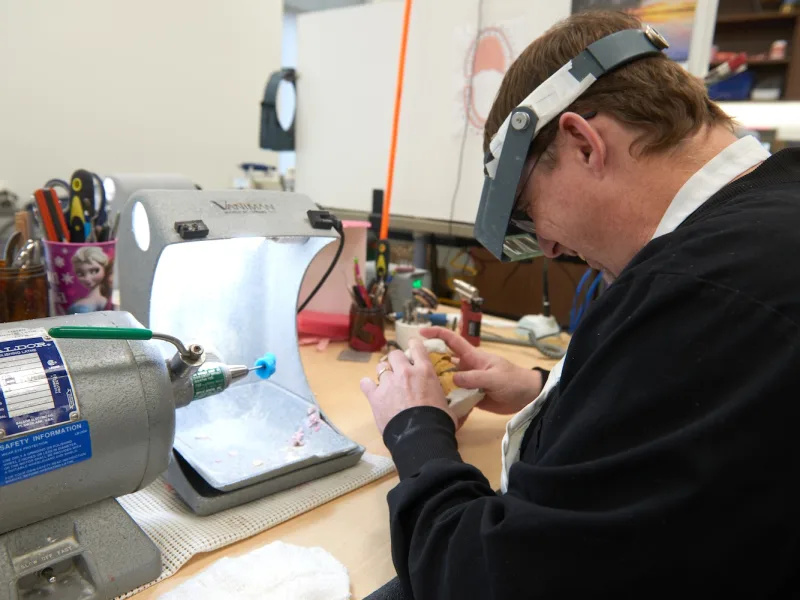
A crown covers a tooth completely, holding it together when a filling is no longer enough. It is the standard answer for a cracked tooth, a tooth that has had a root canal, or a tooth worn thin by grinding. Ours are designed and milled in the laboratory inside our building, which is why the shade and the bite tend to be right the first time.
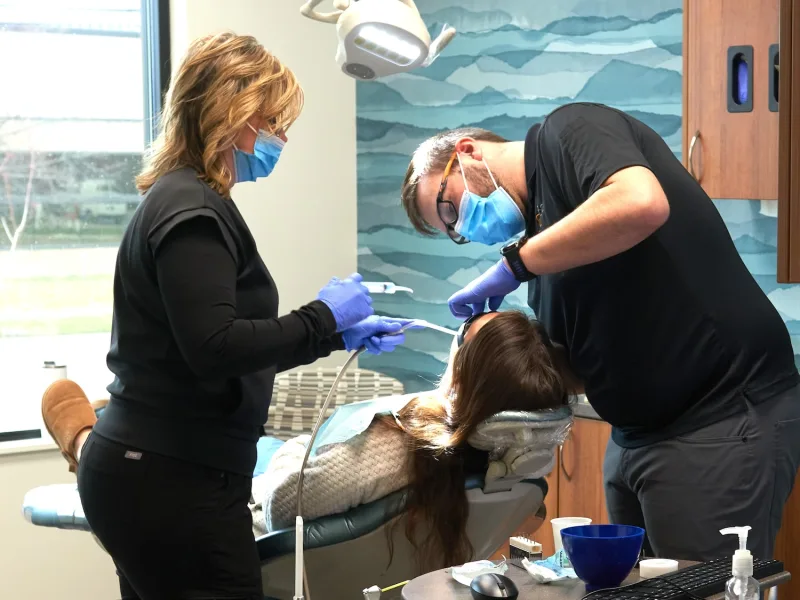
We check how much sound tooth structure remains, test for cracks, and evaluate your bite. If a filling will hold, we will tell you so rather than recommending a crown by default.
Step 2
Preparation and digital scan
The tooth is shaped under local anesthesia and scanned digitally, no impression tray for most patients. You leave with a temporary crown while the final one is made.
Step 3
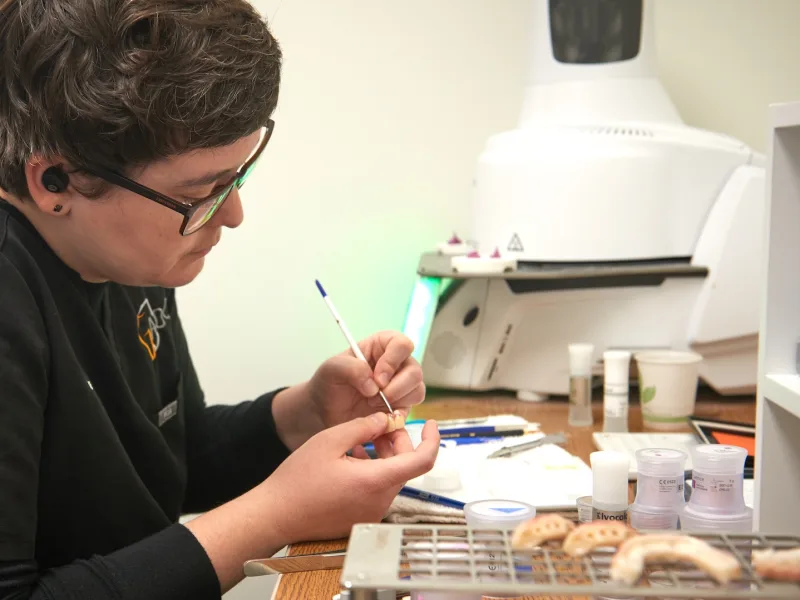
Milled and matched on site
Our laboratory fabricates the crown here, matching shade and translucency with your tooth in front of them, then we fit it and refine the bite before cementing.
Why patients choose it
Benefits of crowns
Holds a cracked or weakened tooth together under chewing force
Protects a tooth after root canal treatment from fracturing
Restores teeth worn down by grinding back to proper height
Custom shade matching for a natural, unnoticeable result
Sealed margins help prevent new decay under the restoration
Made in our own lab, so adjustments are fast and precise
The basics
About crowns
Teeth are strongest when intact. Every time a tooth is drilled and filled, the remaining walls get thinner, and a large filling can act like a wedge that eventually splits the tooth. A crown reverses that geometry. Instead of filling a hole from the inside, it wraps the tooth from the outside and holds the remaining structure together under chewing load.
That is why crowns are recommended after root canals, on teeth with cracks, and on teeth where an old filling has grown so large that little natural tooth is left. The decision point is usually how much healthy tooth structure remains: below roughly half, a filling is repairing a tooth that is already at risk of fracturing.
New Patient Special
FREE Electric Toothbrush
Complete your first appointment and get a FREE electric toothbrush. Your visit includes a dentist consultation, comprehensive exam, X-rays if needed, a detailed oral scan, and a cleaning if applicable.
If the damage is limited, a filling is less invasive, less expensive, and the better choice. We would rather place one. If a tooth is missing entirely, a crown is not the answer; you are looking at an implant or a bridge instead. And if several teeth need crowns because the bite has collapsed, the case is better planned as full-mouth reconstruction so the restorations are designed together.
What our laboratory adds
The most common complaints about crowns are that the shade is off or the bite feels high. Both are far easier to prevent when the laboratory is in the same building.
Our technicians can look at your adjacent teeth directly, the way light passes through the edge, the slight variation in color from the gum line to the tip. Photographs and written shade codes lose that information. And when a bite needs a tiny adjustment at delivery, the person who milled the crown is available immediately.
Caring for a crowned tooth
Brush and floss normally. Crowned teeth need flossing more than most, because the margin at the gum line is where problems start. If you grind your teeth, a custom night guard protects both your crowns and your natural teeth from the force. Keep up with regular cleanings so we can check the margins while any issue is still small.
Think you may need a crown, or have one that is bothering you? Book an appointment and we will give you a straight assessment.
Still have questions? Contact us: we're happy to help.
How long does a crown last?+
Well-made crowns commonly last ten to fifteen years or considerably longer. Lifespan depends more on hygiene, grinding habits, and the health of the tooth underneath than on the crown material itself.
Does getting a crown hurt?+
The preparation is done with local anesthesia and should be comfortable. Some sensitivity to temperature and pressure for a few days afterward is normal, especially on a tooth that was already inflamed.
How many visits does a crown take?+
Usually two: one to prepare and scan the tooth and fit a temporary, and one to place the final crown. Because our lab is on site, that turnaround is typically shorter than offices that ship cases out.
What are crowns made of?+
Most of ours are all-ceramic or zirconia, which look natural and are strong enough for back teeth. Metal-based options still make sense in some situations. We will explain the trade-offs for your specific tooth.
Crown or filling. How do I know which I need?+
It comes down to how much healthy tooth is left. Small to moderate damage is well handled by a filling. Once a cusp is cracked, a large old filling is failing, or the tooth has had a root canal, a crown is the more predictable choice.
Will the crown look like my other teeth?+
That is the goal, and it is where an in-house lab genuinely helps. Our technicians match shade, translucency, and surface texture with your tooth in front of them rather than from a written shade code.
Can a crown get a cavity?+
The crown itself cannot decay, but the natural tooth beneath it can, particularly at the gum margin. Daily flossing around crowned teeth and regular cleanings are what keep them lasting.
What if my crown comes loose or falls off?+
Call us. Do not try to re-cement it yourself with household adhesive. Keep the crown, avoid chewing on that side, and we will get you in to assess whether it can be re-cemented or needs remaking.
“Life Changing Transformation.
My teeth were a wreck. I had missing, broken, and discolored teeth. I had to watch what I ate because food would always get stuck in my teeth. I rarely ever smiled, and never when my picture was taken.
Best investment of my life, so glad that I found Dr. Greenland, can’t say enough about how amazing he is and the master craftsmanship Dentistry he does!
Dr. Greenland’s staff and facility is also amazing!
Dr. Greenland and Dentistry Team, I want you to know that I am very appreciative of the work, time, effort and professionalism you put into my Dental reconstruction. Thank you!
Eric”
ESE. ShieldsVerified review · Google”
“Best people ever thoughtful considerate couldn't be better”
DVDebbie VromaVerified review · Google”
“I have been treated with nothing but compassion with all the issues I have had, they are redoing implants both upper and lower that someone else did that have been giving me problems for five years. I am more than halfway through the process and can really feel the improvements, I am very grateful that I was referred to Greenland Advanced Oral Care. Everyone is just amazing they really care about you, I would highly recommend them.”